01
Personal Growth
Students want social experiences to support deeper self-understanding—not simply fill their time.
Students seek deeper self-understanding.
They often plan for study, but rarely plan for their overall life experience.

Social Experience Platform
A social experience platform that helps college students discover activities, understand what to expect, and feel confident joining in.

Project Overview
Ciao is a social experience platform designed for college students who want a more active social life but often hesitate because of uncertainty, social pressure, and fragmented event information.
Rather than simply showing more events, Ciao helps students understand what to expect, discover relevant activities, and feel more confident taking the first step.
Outcome
The final concept connects curated event discovery, event details, calendar planning, participation confirmation, and group chat into one continuous experience.
Through usability testing and iterative refinement, we simplified key actions, improved information hierarchy, and reduced moments of hesitation throughout the journey.
My Role
As UX Lead,I translated research findings into the product strategy and structured Ciao's end-to-end experience—from discovering an event to joining the first conversation.
I led research synthesis, information architecture, core user flows, wireframing, prototyping, and usability validation, while collaborating with the team on visual design and final product direction.
Research Plan
We combined quantitative and qualitative research to understand how college students discover, evaluate, and participate in social activities.
48
Survey responses
10
User interviews
09
Shadowing sessions
08
Cultural probes


Shadowing
Observing how students move through everyday social spaces.

Research synthesis
Comparing patterns across survey and interview responses.

Cultural probe
Capturing routines and emotions outside formal interviews.
Affinitization
We grouped repeated behaviors and statements, combined overlapping patterns, and distilled the evidence into four opportunity areas.
600+
Evidence notes
114
Initial clusters
63
Synthesized findings
4
Opportunity areas

Research Synthesis
We compared recurring behaviors and statements across methods, clustered related evidence, and translated those patterns into four themes that could guide the product direction.
Key Insights
01
Students want social experiences to support deeper self-understanding—not simply fill their time.
Students seek deeper self-understanding.
They often plan for study, but rarely plan for their overall life experience.
02
Time with friends is both the motivation for participating and the gateway to a wider social circle.
Students value spending time with friends and are eager to expand their social circles.
03
Students look for activities that interrupt repetitive routines and add purpose beyond the classroom.
Many students feel stuck in repetitive daily routines.
Students want a better balance between academic responsibilities and personal life.
Club activities add purpose and enrichment to extracurricular life.
04
Participation depends on timely information and a club atmosphere that feels welcoming and easy to enter.
Accurate and timely club information is difficult to access.
Indoor club events continue to play a meaningful role.
Students appreciate clubs with a welcoming, friendly atmosphere.
Personas
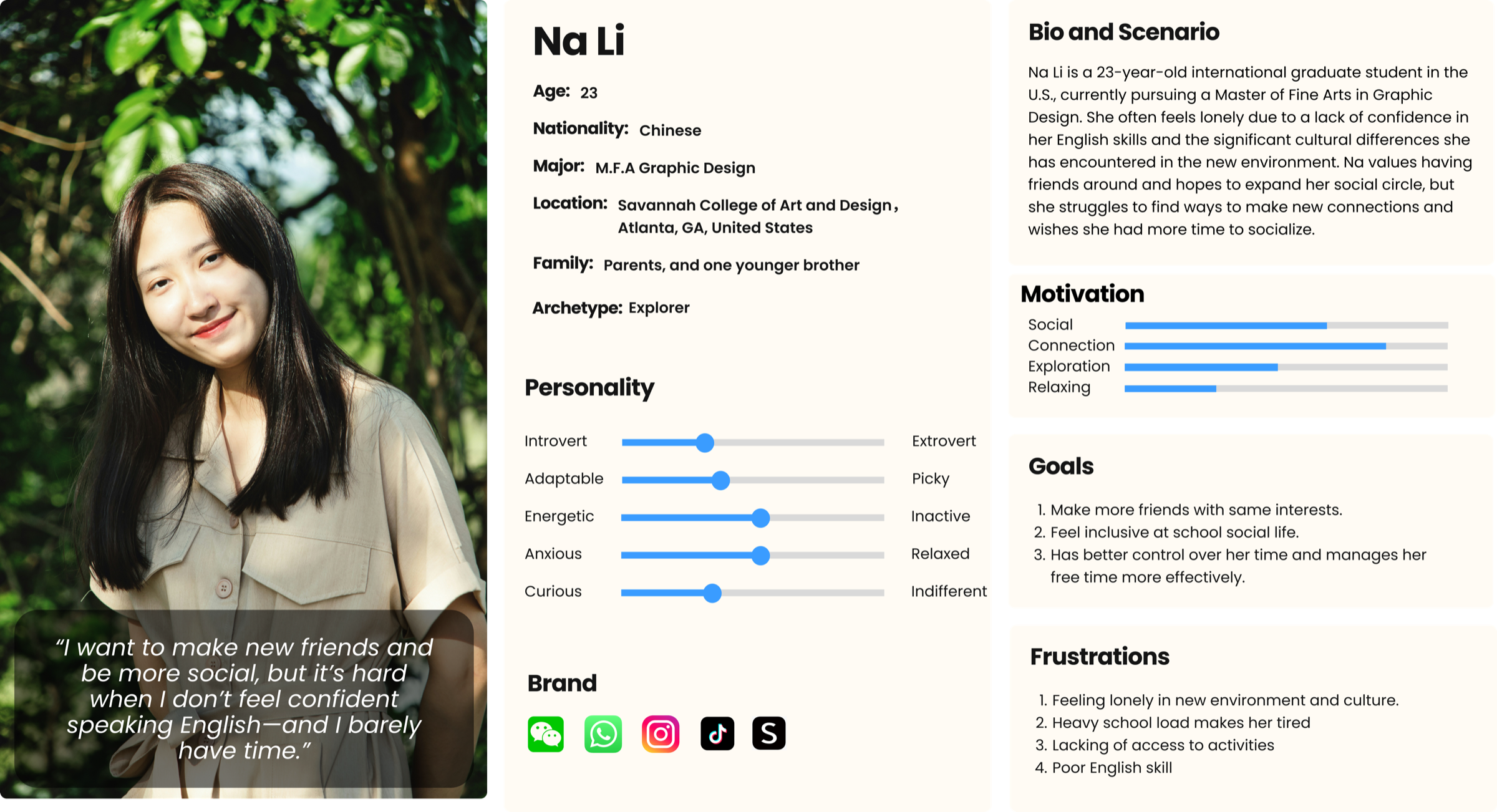
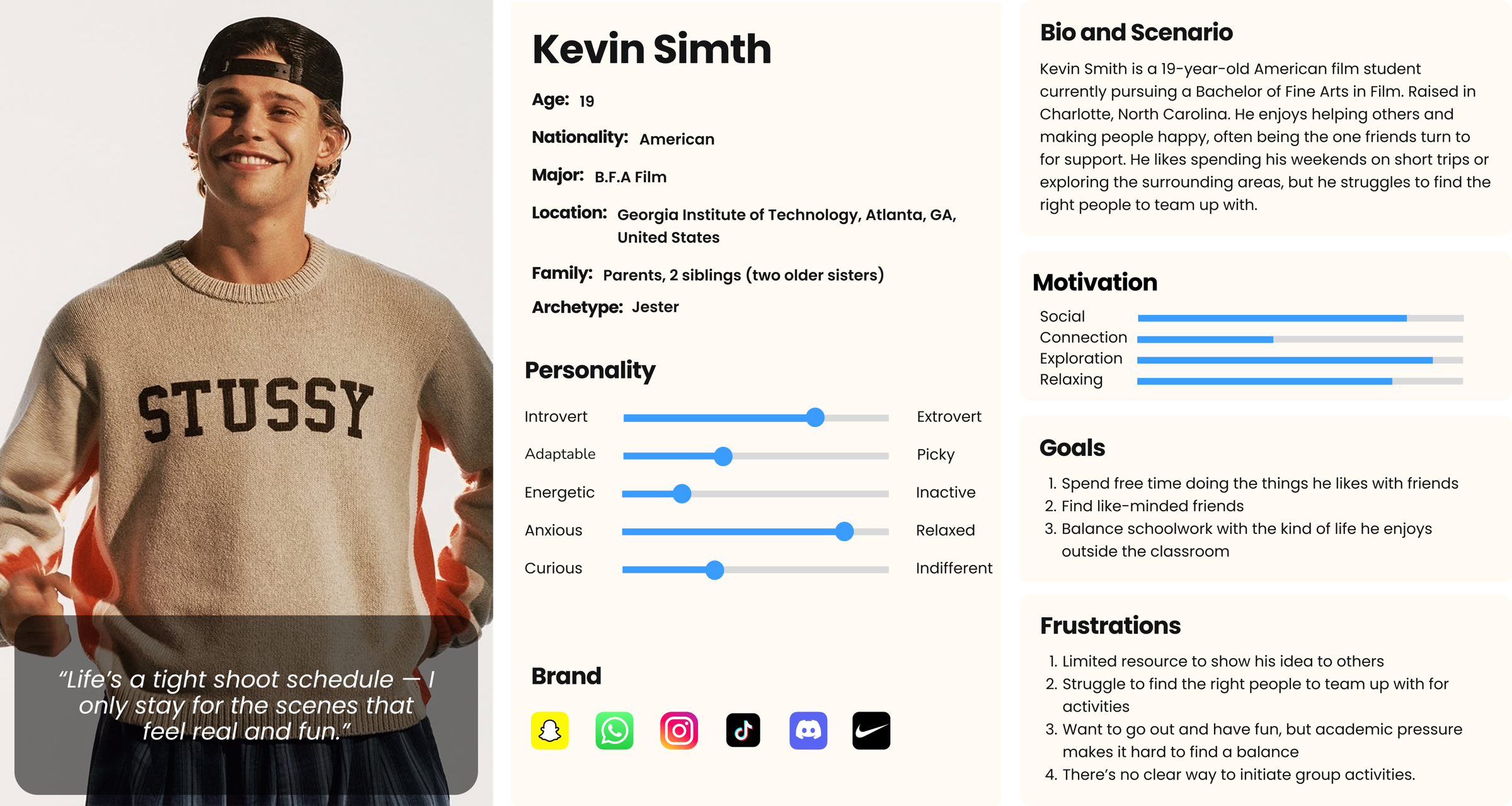
Our personas helped us look beyond a single student background. Na Li needs reassurance when entering an unfamiliar social environment, while Kevin needs an easier way to find the right people and turn shared interests into plans.
How Might We
The research showed that participation is not a single decision. Students first need to find something meaningful, understand what to expect, and feel socially supported enough to join. These connected needs shaped the experience we explored through ideation.
How might we reduce uncertainty and help college students feel confident taking the first step toward a social activity?
Unclear expectations / social pressure / fear of joining alone
How might we help students discover activities that feel personally relevant and meaningful beyond the classroom?
Repetitive routines / personal growth / relevance to interests
How might we help students feel welcomed and connected before, during, and after joining an activity?
Reliance on friends / inclusive atmosphere / lasting connection
Guiding How Might We
How might we help college students move from discovering a relevant activity to confidently participating and connecting with others?
User Scenarios
During ideation, we sketched two connected scenarios to explore how Ciao could support both sides of a shared activity: someone organizing it and someone deciding whether to join.
01 · Event organizer
Kevin has an idea for a social activity but needs a clearer way to turn it into a plan and find people who want to join.

01
Finds an idea

02
Creates the event

03
Sees people join
02 · Event participant
Lina wants to meet people through a relevant activity and needs enough context and reassurance to feel comfortable joining.
01
Discovers and joins

02
Takes part

03
Stays connected
Future-state Journey Maps
During ideation, we mapped a possible journey for each persona—from the first social impulse to taking part and staying connected. This helped us identify where Ciao could reduce uncertainty and support better decisions.
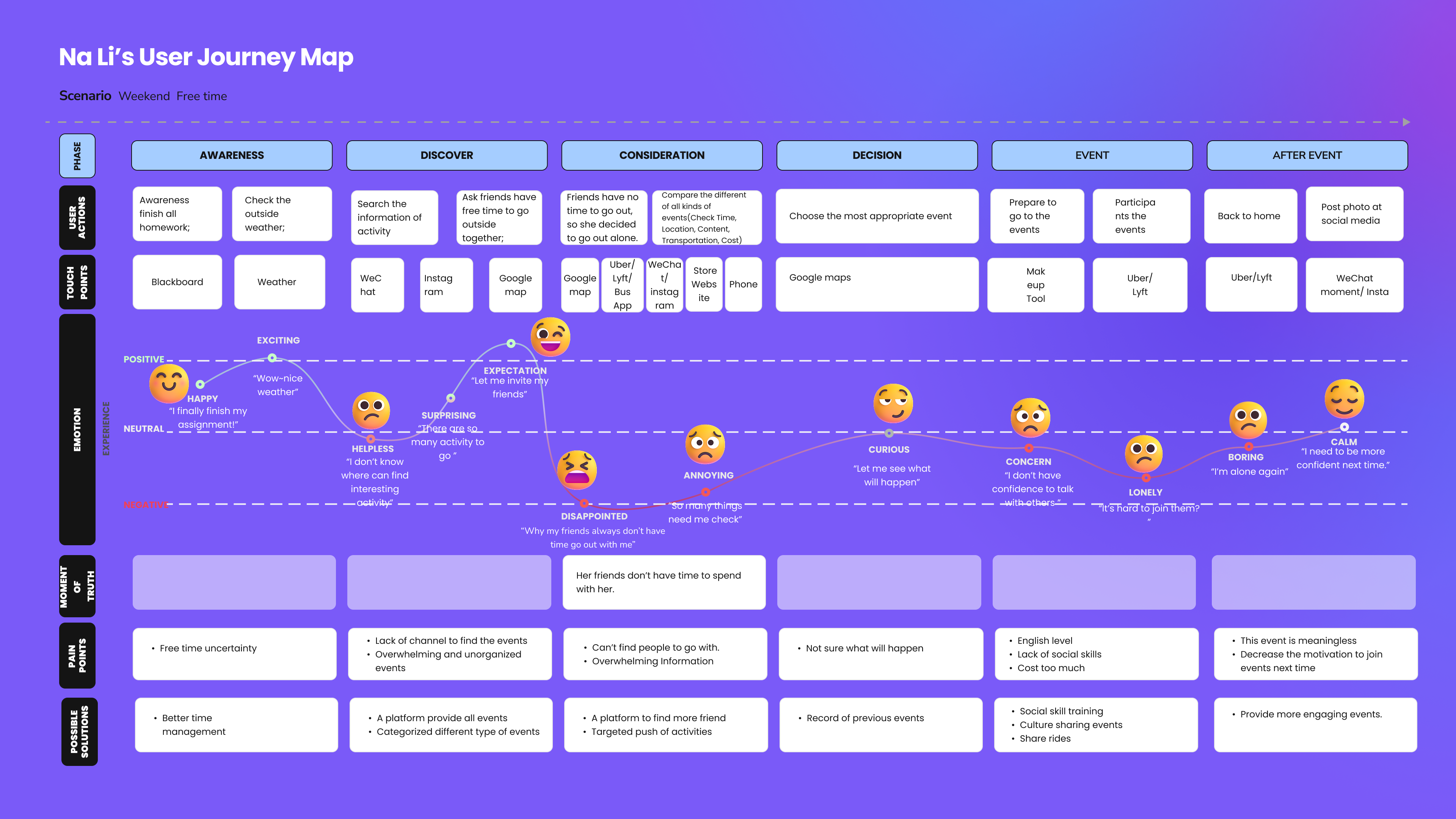
01 · Participant journey
Na Li
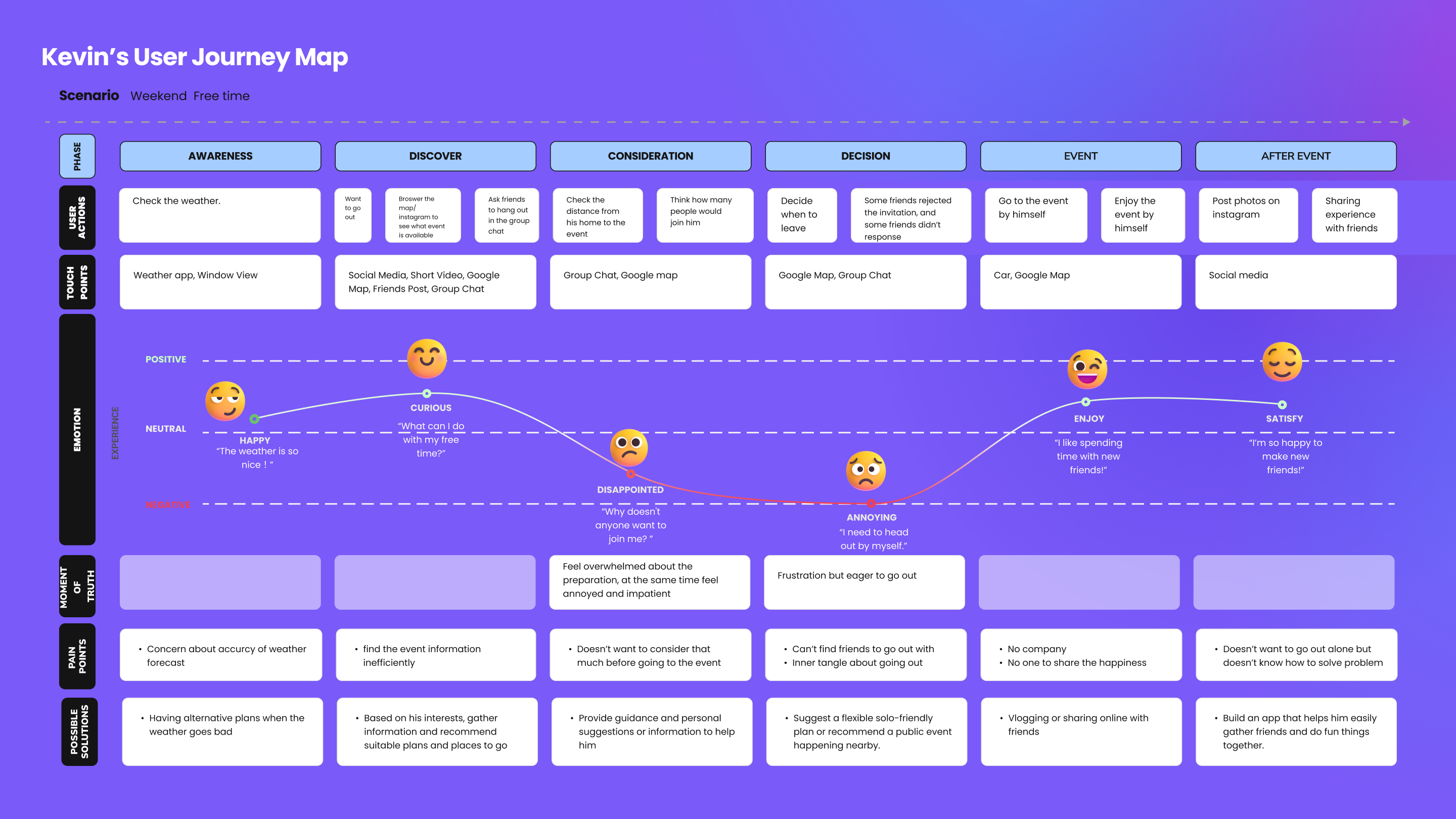
02 · Organizer journey
Kevin
Design direction
We first opened up the solution space, then organized possible features into a clear product hierarchy before drawing the first screens.
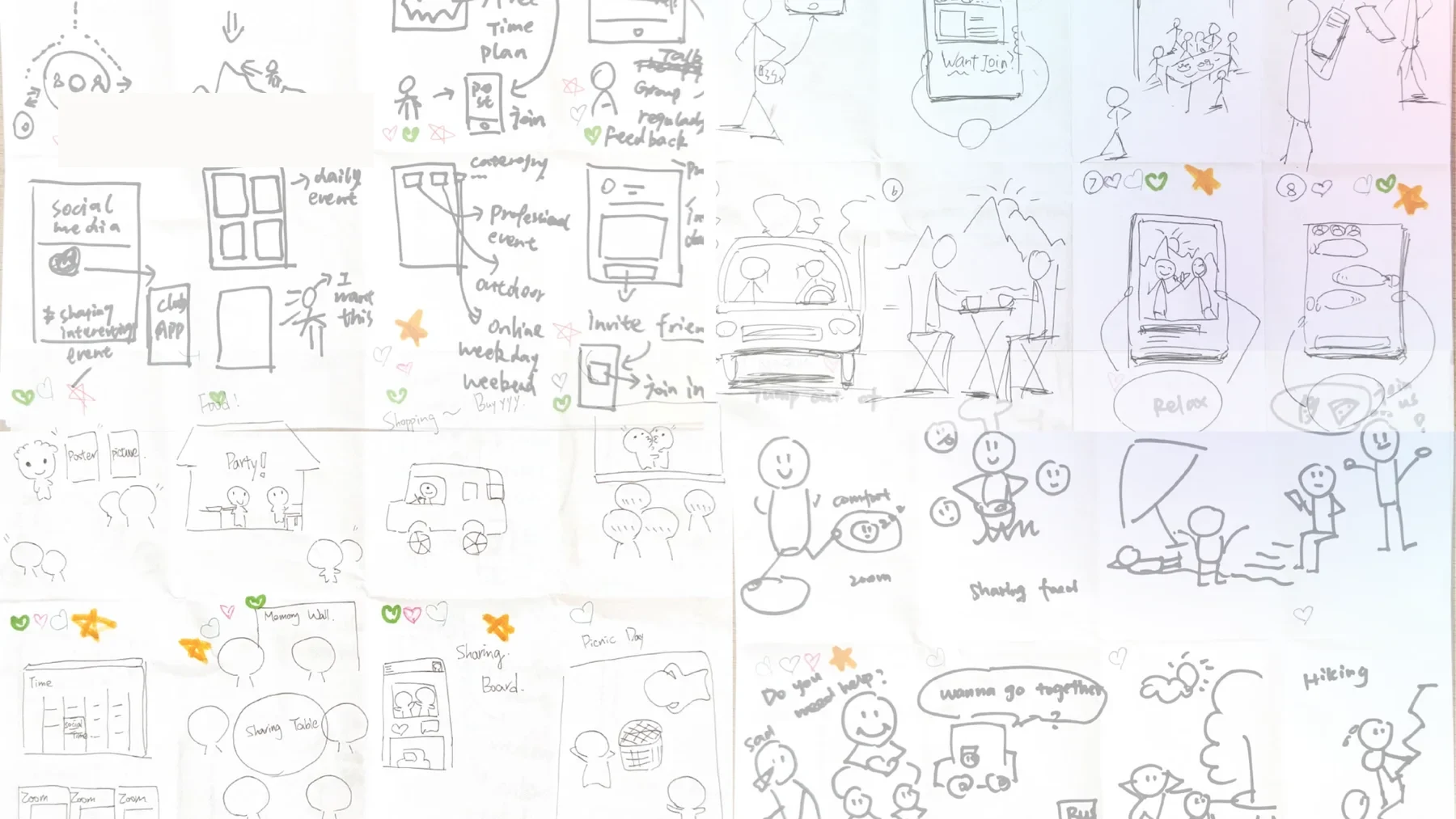
Diverge
We sketched quickly and without judging feasibility, exploring different ways students could discover, organize, join, and remember shared activities.
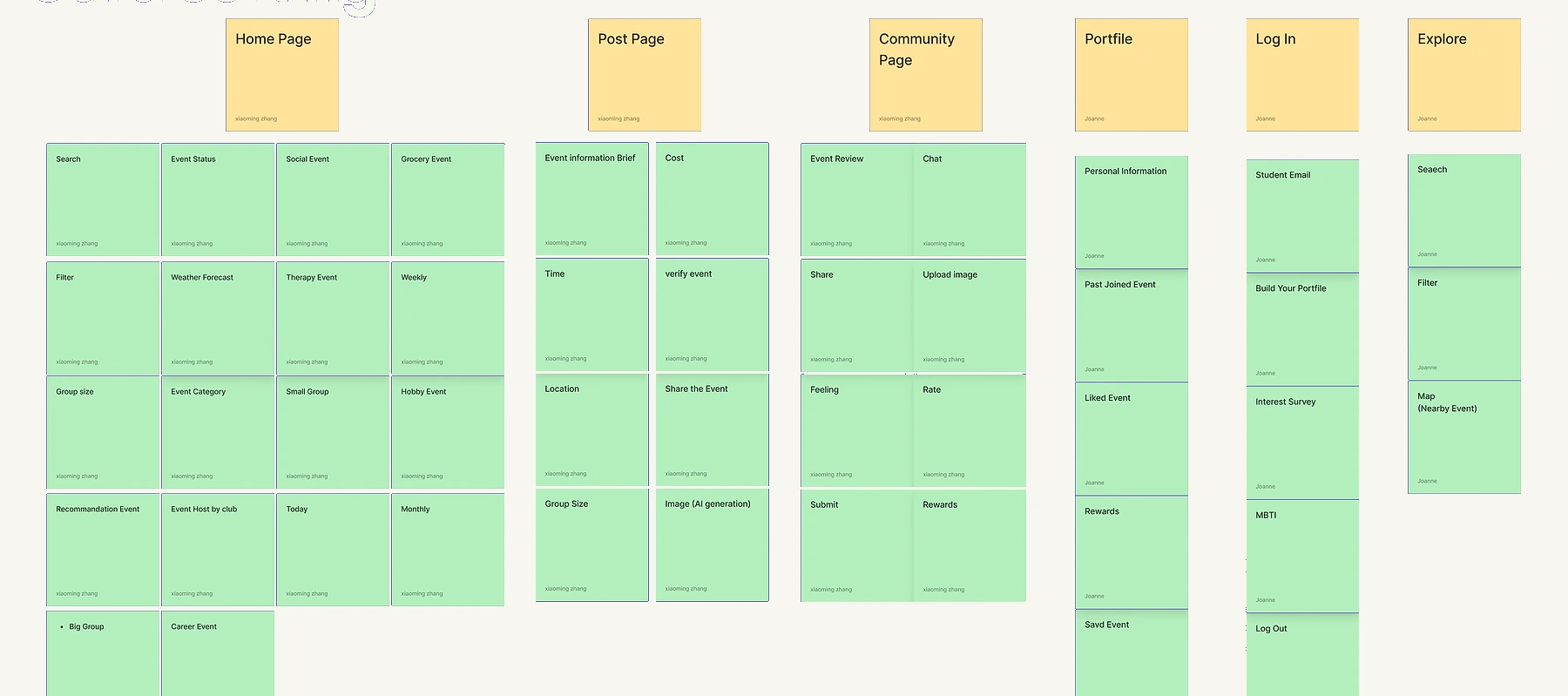
Organize
As a team, we grouped related functions and aligned on five primary areas. The exercise exposed overlap, clarified labels, and gave the product a simpler organizing logic.

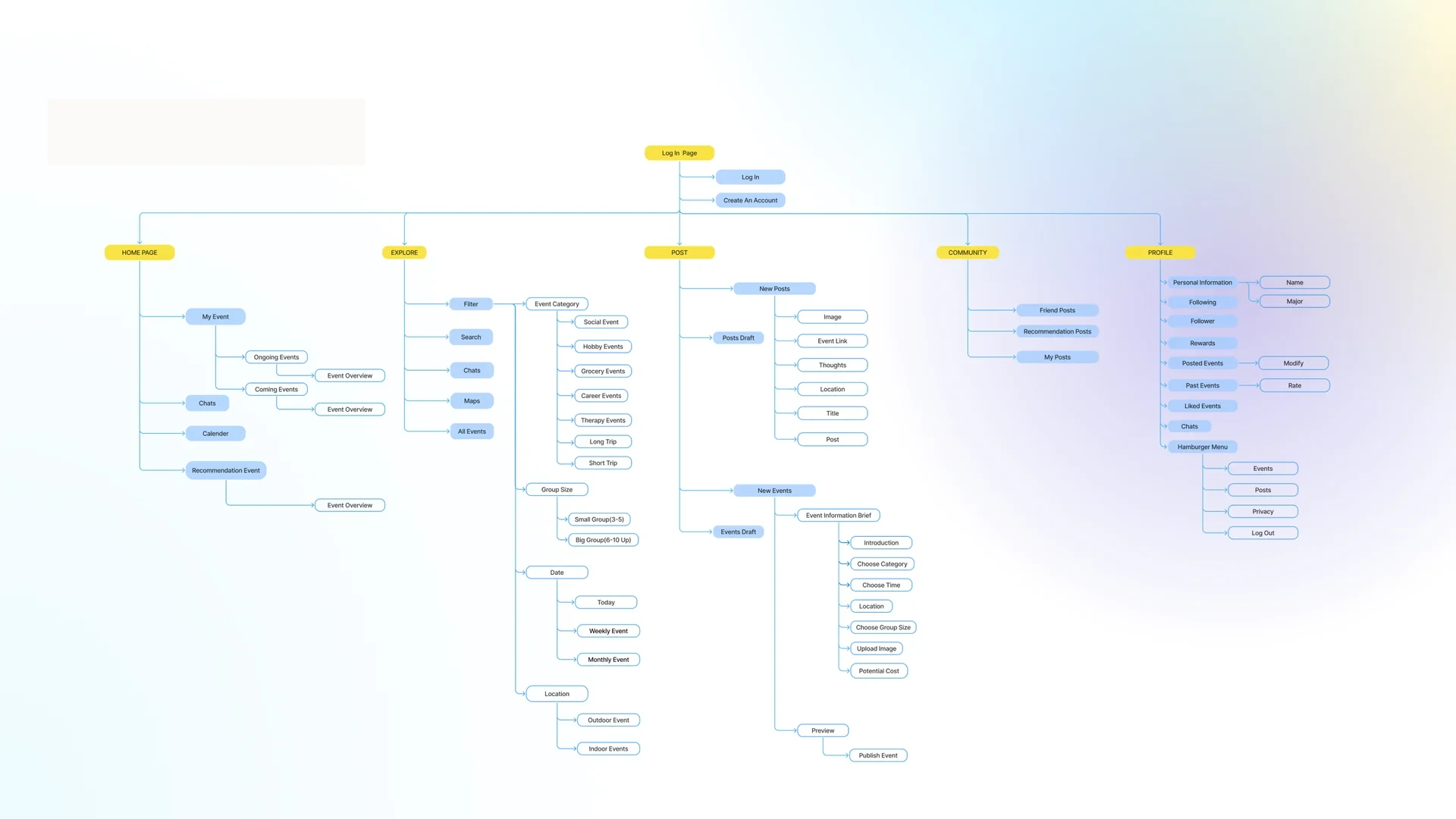
Structure
The card-sort categories became the foundation for the sitemap. Discovery remained primary, while posting, community, and profile functions stayed accessible without competing with the main journey.
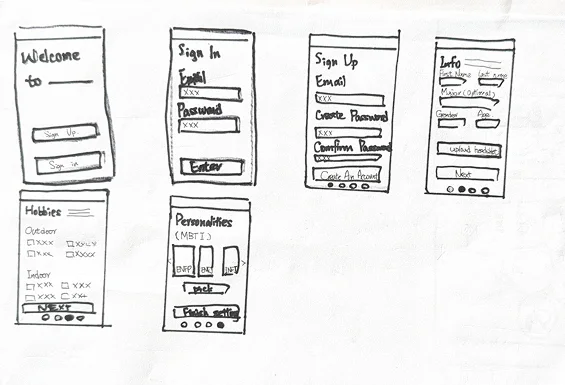
Make concrete
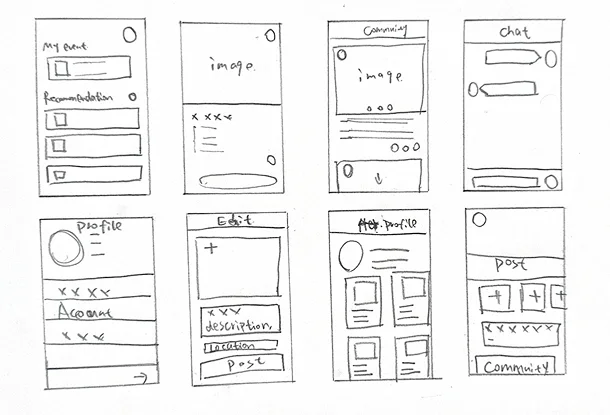
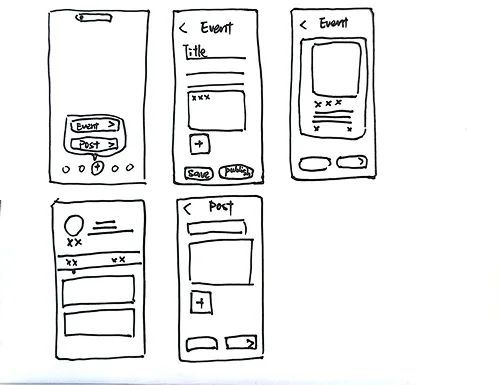
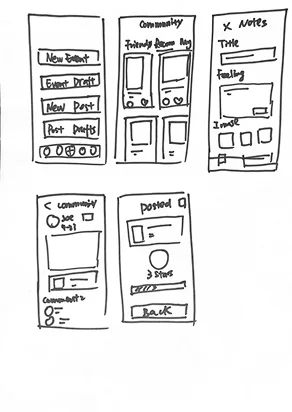
With the hierarchy established, we moved into paper wireframes for onboarding, event discovery, posting, community, and profile flows—turning the structure into screens we could discuss and revise quickly.
Design principles
01
Reduce overwhelm
Curate choices and make event information easy to scan.
02
Lower social risk
Show enough context to make attendance feel predictable.
03
Trigger action
Turn interest into one small, reversible next step.

Brand system
The identity balances the energy of meeting someone new with enough calm and clarity to make the first step feel easy.
01 · Name and voice
A simple greeting
“Ciao” can open or close a conversation, making the name informal, familiar, and easy to remember.
A bridge between people
Its sound also echoes 桥 (qiáo), “bridge” in Chinese—a metaphor for helping students form new connections.
Step out, say ciao.
02 · Color with intent
Invitation
#F9E346
Energy and a clear invitation to act
Openness
#A5CDFF
Calm, approachable spaces for discovery
Trust
#3A9CFF
Clarity and reassurance at key moments
Identity
#7A5AF8
Creative, social, and distinctly Ciao
Black, white, and soft gray support hierarchy and readability, keeping the brighter colors purposeful rather than decorative.
Typography
Poppins
Rounded geometric forms keep product information contemporary and legible while maintaining a friendly character.
Tone of voice
Youthful · Friendly · Refreshing
Chill · Fun · Low-pressure · Creative
Eleven participants completed four core flows. SUS, NPS, focus groups, and expert reviews helped us separate surface-level preferences from moments that genuinely blocked action.
76.59
Average SUS score
38.9/45
Expert review score
+36%
NPS improvement

From evidence to iteration
01
The revised entry experience reduced ambiguity and gave the product a clearer, friendlier first impression.

02
Separating today from upcoming events made schedules easier to scan and helped users plan with more confidence.

03
Focusing the menu on the most common actions reduced hesitation and helped users complete tasks faster.

04
Clearer hierarchy and location context turned the map from decoration into a useful discovery tool.

The final experience supports students before, during, and after an event: discover something relevant, understand what to expect, join with confidence, and stay connected.

01 · Discover
Curated discovery and time-based grouping reduce the work of deciding where to start.

02 · Create
Focused actions make it easier to create a post or event without second-guessing the format.

03 · Connect
Social context gives users a clearer sense of who is participating and what the experience will feel like.

04 · Collaborate
Partnership tools help the platform offer richer, more trustworthy experiences beyond campus listings.

Ciao taught me that event discovery is only the visible part of the problem. The deeper challenge is helping people feel informed, expected, and welcome before they arrive.
Skills demonstrated
Mixed-method research, synthesis, and interaction design: translating students’ social hesitation into clearer event information and participation flows.
What I learned & what comes next
Designing for participation means addressing uncertainty before arrival. Next, I would test repeat participation across a semester and explore the feasibility of interest-based recommendations.